CS2 Supply Chain Safety: Baijin Chemical Emergency Drill
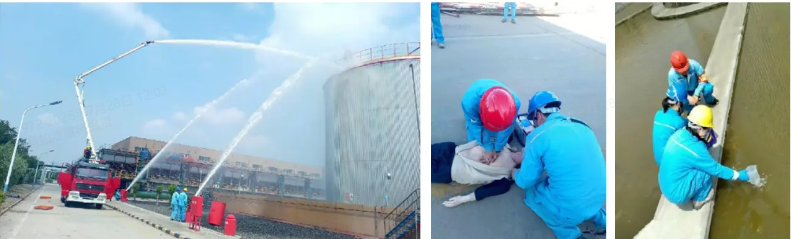
On June 17, 2026, Baijin Chemical, a global leader in the production of Carbon Disulfide (CS2) and Sodium Hydrosulfide (NaHS), successfully conducted a large-scale specialized emergency response drill at its core Carbon Disulfide (CS2) Tank Farm. Organized in strict alignment with the 23rd National "Safety Production Month," the exercise was designed to rigorously test the company’s high-pressure response capabilities, technical resilience, and its "Safety First, Prevention Foremost, and Comprehensive Management" policy. By simulating a complex cascading failure, Baijin Chemical demonstrated its unwavering commitment to maintaining a stable and secure global supply chain for its industrial partners.
A High-Level Command Structure for Industrial Excellence
The complexity of handling Carbon Disulfide—a critical yet highly volatile industrial chemical—requires more than just equipment; it demands a sophisticated organizational hierarchy. The drill was directed by a high-level command team, reflecting the priority Baijin Chemical places on operational security.
General Manager Lv served as the Commander-in-Chief, overseeing the strategic deployment of tasks and the management of real-time information release. Supporting the strategic front, Safety Director Cui acted as the Deputy Commander, establishing a localized, on-site command system to bridge the gap between high-level decision-making and tactical execution. This leadership structure ensures that in the event of a real-world disruption, the transition from normal operations to emergency response is seamless, minimizing potential downtime and protecting the interests of global stakeholders.
High-Fidelity Simulation: Addressing the Complexities of CS2
The drill utilized a high-fidelity scenario designed to challenge every layer of the facility's safety infrastructure. The simulated incident began with a valve failure leading to a significant CS2 leak. In this scenario, static electricity ignited the escaping vapors, resulting in a localized fire and simulated personnel injury.
For a global manufacturer like Baijin Chemical, which operates under a rigorous ISO Quality Control System, these simulations are vital. They provide the empirical data necessary to validate the integrity of the Carbon Disulfide (CS2) Tank Farm’s containment and suppression systems.
The Four-Pillar Response Procedure: Technical Execution
The success of the drill was rooted in a four-pillar response strategy, integrating advanced technology with precise engineering maneuvers:
1. Process Emergency: Source Isolation
The immediate priority was the isolation of the hazard. Technical teams executed "Process Emergency" protocols, which involved the rapid closing of upstream and downstream valves to cut off material flow. Simultaneously, the "Tank Transfer" protocol was initiated, moving the contents of the compromised vessel to a secure backup tank. This proactive containment strategy is a hallmark of Baijin’s risk management, ensuring that an incident remains localized and manageable.
2. Firefighting and Rescue: Suppression and Cooling
To combat the simulated fire and mitigate the risk of thermal expansion in adjacent tanks, the facility’s firefighting units deployed high-pressure water monitors. These monitors served a dual purpose: the direct suppression of flames and the continuous cooling and dilution of vapors. The use of specialized chemical protective equipment ensured that personnel could operate in close proximity to the hazard without compromising their personal safety.
3. Engineering Rescue: Advanced Pressure Leak-Plugging
A critical technical highlight of the drill was the application of pressure leak-plugging equipment. Under the safety cover of high-pressure water monitors, the engineering rescue team moved into the "Hot Zone" to perform a live seal on the damaged valve. This capability—executing repairs while the system remains under pressure—is a sophisticated engineering feat that significantly reduces the time required to regain control of a facility during a crisis.
4. Environmental Monitoring: Protecting the Ecosystem
Consistent with its ISO 14001 commitments, Baijin Chemical integrated real-time environmental monitoring into the drill. Teams tracked downwind toxic gas concentrations and monitored the flow of wastewater to ensure that firefighting efforts did not lead to secondary environmental contamination. This ensures that the company remains a responsible steward of the environment even during emergency conditions.
Strategic Significance: The Final Line of Defense
The strategic value of these drills extends far beyond the factory gates. As a primary supplier to the global pesticide, pharmaceutical, and chemical fiber industries, Baijin Chemical recognizes that any disruption in its production affects the entire downstream value chain.
During the post-drill briefing, General Manager Lv Yuxing emphasized the company's philosophy: "Emergency drills are the final solid line of defense for production safety. We must adhere to 'training through drills and maintaining combat readiness through practice' to ensure that when emergencies occur, we have plans, capabilities, and the power to prevail."
By normalizing and consolidating these emergency response capabilities, Baijin Chemical ensures a continuously stable production safety environment. This proactive stance fulfills the corporate commitment of "Safety for everyone, Emergency skills for everyone," and provides global customers with the assurance that their supply of CS2 and NaHS is protected by world-class safety standards.
Conclusion: A Foundation of Reliability
The June 17 drill at the CS2 Tank Farm confirms that Baijin Chemical’s market leadership is built on a foundation of technical rigor and safety excellence. Through the combination of advanced Professional Protective Equipment, a disciplined command structure, and high-intensity practical drills, the company continues to set the benchmark for safety in the global chemical manufacturing industry.
Frequently Asked Questions (FAQ)
Q1: Why is the CS2 Tank Farm drill significant for Baijin Chemical’s global customers?
A: For B2B partners, supply chain continuity is paramount. These drills validate that Baijin Chemical has the technical expertise and emergency protocols to handle incidents without prolonged shutdowns, ensuring a reliable and stable supply of Carbon Disulfide and Sodium Hydrosulfide for global markets.
Q2: What specific safety standards does Baijin Chemical adhere to?
A: Baijin Chemical operates under a comprehensive ISO Quality Control System and adheres to a strict Safety Production Policy characterized by "Safety First, Prevention Foremost, and Comprehensive Management." This includes compliance with both national safety standards and international chemical handling best practices.
Q3: What specialized equipment is used during an emergency at the CS2 facility?
A: The facility is equipped with professional chemical protective gear, high-pressure water monitors for cooling and suppression, and specialized pressure leak-plugging equipment that allows for the repair of damaged valves under operational pressure.
Q4: How does Baijin Chemical manage environmental risks during a chemical leak?
A: The company employs real-time environmental monitoring to track downwind gas concentrations and monitors wastewater flow during emergency responses. This ensures that any incident is contained not just physically, but also environmentally, preventing secondary contamination.
Q5: What is the "Process Emergency" protocol mentioned in the drill?
A: The Process Emergency protocol involves immediate valve closure to stop material flow and "Tank Transfer"—moving the chemical from a damaged tank to a secure one. This is the primary method for isolating a hazard at its source.
Q6: Who leads the emergency response efforts at Baijin Chemical?
A: Emergency responses are led by a high-level command team, typically headed by the General Manager (acting as Commander-in-Chief) and the Safety Director (acting as Deputy Commander), ensuring that the company’s top management is directly involved in safety and risk mitigation.
Q7: How often are these specialized drills conducted?
A: While the June 17 drill was a focal point of the 23rd National Safety Production Month, Baijin Chemical maintains a policy of "normalizing" emergency response through regular training and "training through drills" to maintain a state of constant combat readiness.