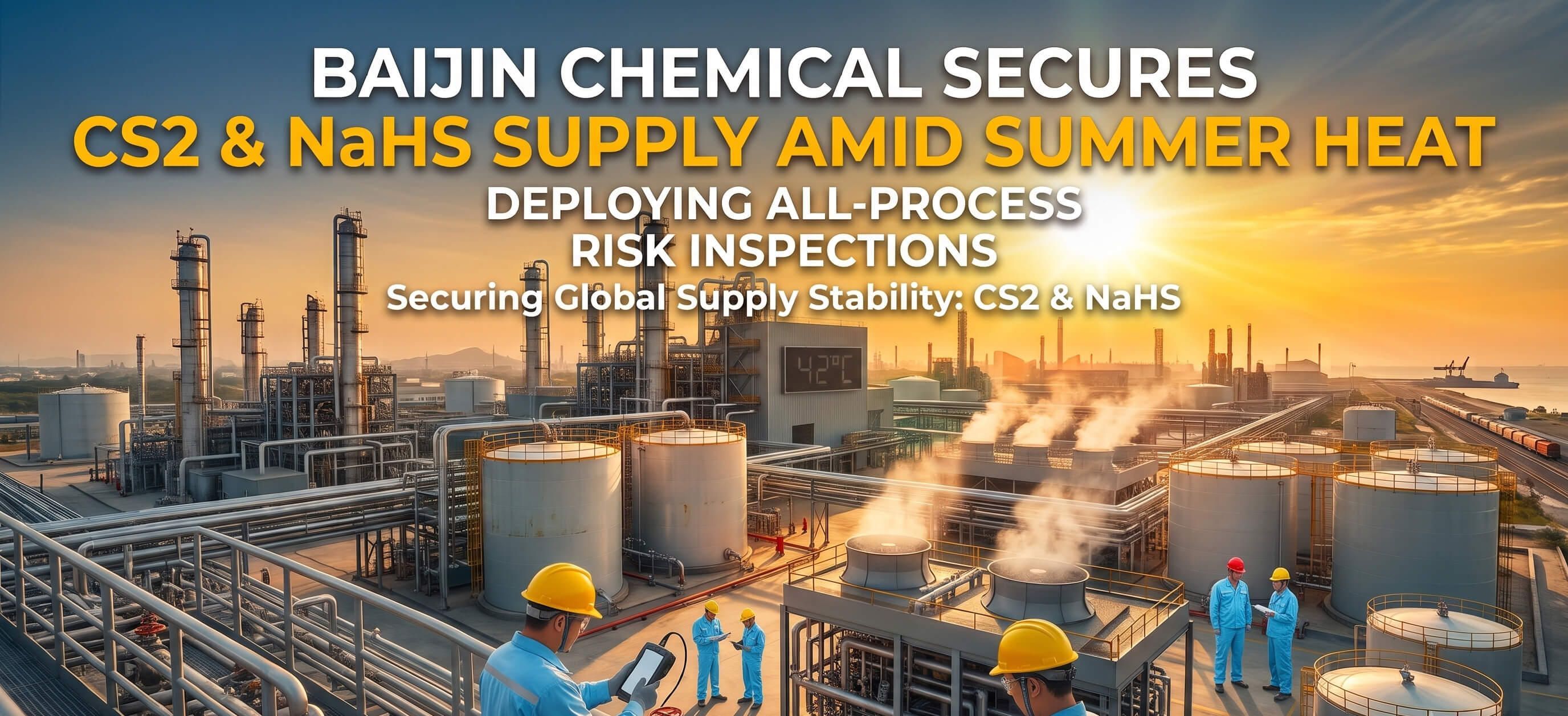
Baijin Chemical Secures CS2 & NaHS Supply Amid Summer Heat
On June 15, 2026, Zhang Zhaohui, General Manager of Baijin Chemical, convened a Summer Safety Production Emergency Meeting at the group headquarters. Facing unprecedented seasonal heat, the group has launched a comprehensive risk inspection across its five production hubs to ensure the uninterrupted supply of Carbon Disulfide (CS2) and Sodium Hydrosulfide (NaHS).
Proactive Crisis Management in Extreme Conditions
As global temperatures reach seasonal peaks, the chemical manufacturing industry faces heightened risks regarding volatile substance stability and pressurized system integrity. Recognizing these challenges, Baijin Chemical has moved beyond standard protocols. The "Summer Safety Production Emergency Meeting" served as the launchpad for a coordinated, group-wide offensive against potential industrial hazards. General Manager Zhang Zhaohui emphasized that for a company in the sulfide industry, "Safety is not merely a regulatory requirement but the bedrock of our global delivery commitment."
The initiative focuses on two critical fronts: the fortification of intrinsic process safety within the factories and the rigorous tightening of logistics and transport controls for hazardous materials.
The emergency meeting outlined a series of mandatory operational directives designed to mitigate the thermal impact on chemical stability. A "Dual Responsibility" system has been consolidated, ensuring that safety accountability is not just a management concept but a post-specific duty for every operative on the grid.
1. All-Process Risk Inspections
Technicians across all five modern sulfide chemical factories in mainland China and India are currently conducting exhaustive audits of production units. Special attention is being paid to cooling systems, pressure relief valves, and storage tank insulation. Every identified risk is logged into a centralized "hazard tracking ledger" .
2. Rigorous Logistics and "Blacklist" Implementation
Transporting Class 8 corrosive chemicals and highly flammable substances like CS2 requires specialized expertise. Baijin Chemical has strengthened its protocols for the loading and unloading of sulfuric acid and other raw materials. Most notably, the group has implemented a "Blacklist" policy. Any third-party logistics provider failing to meet the stringent safety standards for hazardous goods transportation—including MSDS compliance and proper maritime declaration—will be permanently barred from the Baijin partnership network.